Vietnam
The SympathizerVietnam is the unnamed narrator’s homeland, but never a simple place of belonging: it is a country divided by war, lost to exile, returned to under a new regime, and finally left again by boat. Its changing political realities give physical form to the narrator’s divided identity. The country is at once the home he says he was born in, the place he serves through underground work, and a revolutionary society that ultimately has no place for him.
Homeland and divided belonging
The narrator’s account opens in April, when the long war is approaching its end. He waits behind the walls of a villa where he has lived for five years, surrounded by broken glass and rusted barbed wire. The room in which he waits resembles the isolation cell in which he later addresses The Commandant. This parallel makes the country’s apparent transition from war to peace feel less like release than a change in the form of confinement. The month is an ending, but the narrator cannot name what follows as peace.
Vietnam is also the answer to an argument about where the narrator belongs. He tells Man that he does not belong in America, and that although he was born in Vietnam, birth alone has not secured his place there. The country’s families and loyalties are divided: some relatives support the north, others the south, some communism, others nationalism. Yet, as the narrator observes, people on opposing sides can all regard themselves as patriots. His own position is more fractured. He is Vietnamese by birth, educated in America, and secretly committed to a cause operating within his homeland.
That division began before exile. At Occidental in Southern California, the narrator spent six years learning American ways of thinking while serving as a spy-in-training under Man’s direction. His education abroad was not a departure from the Vietnamese conflict so much as another front in it. His years in America later sharpen the contrast between knowing a country from within and being treated as someone who does not belong there.
War, service, and political loss
Vietnam is the setting of the narrator’s revolutionary work and the cause invoked by competing political projects. His actions include passing intelligence to Man, even when he understands that the information may lead to deaths. In a remembered conversation at a basilica in Saigon, Man argues that revolutionaries cannot preserve innocence while knowing and doing what their struggle requires. The narrator later recalls that counsel while grieving the death of The crapulent major, whom he regards as relatively innocent. Vietnam’s political struggle thus remains present in exile as a question of responsibility, not merely as a vanished battlefield.
The country also carries the hopes attached to military service. In a speech to Vietnamese exiles, the narrator recalls spending two years in the Highlands with local soldiers, sharing their fears and facing their enemy. He presents their hopes for a better life as sincere, while acknowledging that history has dealt them a different outcome. The Anti-Communist Congressman, speaking at a gathering with The General, frames the fall of Indochina through the Cold War map of countries supposedly saved from communism. The contrast is telling: Vietnam is not simply a homeland lost by its people, but also a place interpreted from abroad through strategic arguments about what its loss supposedly means.
After Saigon falls, the narrator writes to his aunt on its first anniversary. His letter records exile as a collective ordeal: refugees leave their camp only with sponsors who guarantee they will not depend on public welfare. He imagines that, if allowed to remain together, the exiles could form a self-sufficient community containing workers, professionals, religious groups, political differences, and people from the north, center, and south. Such a community might claim a public voice, but the vision also reveals the cost of dispersion: the people of Vietnam must reconstruct a social whole outside the country they have lost.
Exile and the imagined return
For the exiles, Vietnam persists not only as territory but as a measure of time. In the home of The General and Madame, a hardwood clock carved in the shape of the country places its hands in the south and its numbered dial around Saigon. The object turns homeland into a timepiece. The narrator reflects that displaced people may know the distance home is finite, while the years before return seem capable of stretching without end. The recurring question is not merely where the country is, but when return might become possible.
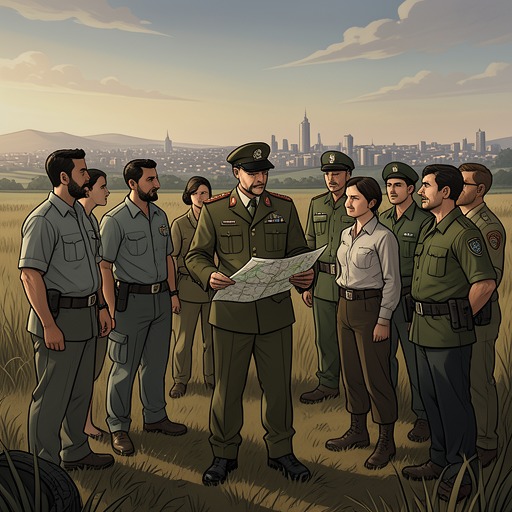
That longing takes organized form in the United States. The General and Madame assemble veterans, arrange uniforms and flags, and cultivate a movement that presents itself as preparation for the recovery of Vietnam. Volunteers train on weekends, and roughly two hundred men gather for maneuvers in the hills east of Los Angeles. The General’s circle also plans to send a reconnaissance team to Thailand. In exile, Vietnam becomes both a memory represented by flags and clocks and a political objective pursued through military preparation.
The narrator’s experiences abroad complicate any uncomplicated story of return. In the Philippines, he sees a government backed by the United States suppress political opponents and reads reports of dissidents found shot in the streets. The sight recalls the authoritarian conditions he associates with Vietnam and unsettles his confidence in revolutionary claims made in the name of the people. He asks why people flee by sea if the revolution serves them. His questions remain unresolved at the time, but they later become part of his understanding of the country he is trying to leave.
Return, repression, and departure
After his reeducation, the narrator concludes that the revolutionary society in Vietnam has no place for people like him, even those who understand themselves as revolutionaries. He says that they cannot be represented there, and that this knowledge outlasts physical pain. Leaving is not what he wants, but it is what he must do. The return to the country has not restored belonging; it has exposed the limits of the political order that claimed to represent its people.
The journey back to Saigon with Bon makes that reversal concrete. After two days on mountain roads and deteriorating highways, they arrive in a city the narrator finds muffled and strangely quiet. The driver explains that Vietnam is again at war: after Khmer Rouge attacks on its western border, the country has invaded Cambodia, while China has raided the northern border. The narrator’s bitter conclusion is that peace has not followed the earlier war. The absence of romantic songs and pop music, once ordinary in cafés and on transistor radios, gives the changed city a cultural silence as well as a political one.
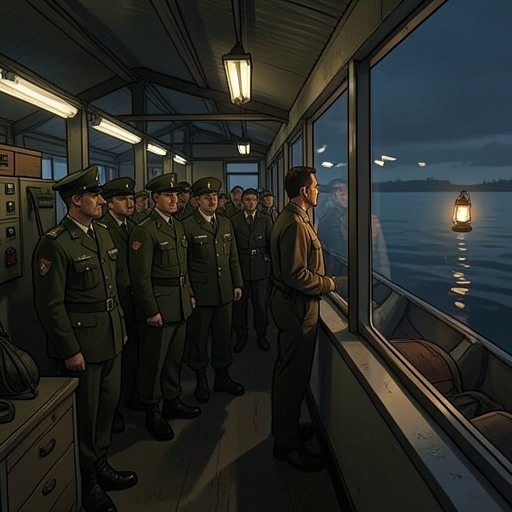
In Saigon, the narrator and Bon prepare to escape by sea. They use gold from the commissar to pay their fares, conceal it in a false bottom in the narrator’s rucksack, and carry a shared cipher in its place. Their plan is specific: leave with families appearing to take a short trip, travel by bus to a village south of the city, and meet a ferryman by the riverbank. The escape joins private necessity to a much larger exodus of refugees from a revolution. The manuscript itself becomes their attempt to represent their own experience before departing.
A homeland carried in memory
Vietnam remains more than a setting the narrator can leave behind. The Saigon-shaped clock makes the country portable as an emblem, while the stories of exile, military organizing, return, and flight make it a continuing political and emotional reference point. The narrator’s relationship to Vietnam is marked by contradiction: he is born there yet feels excluded, serves a revolution yet is rejected by its society, and flees even while continuing to call himself a revolutionary.
The closing vision refuses both easy pity for refugees and easy confidence in a future return. The narrator and Bon anticipate being seen as strange or primitive, but reject that judgment and retain a sense of political hope despite their losses. They leave as people driven from Vietnam, carrying a manuscript intended to resist the versions imposed on them. The country’s significance lies in this unresolved bond: departure is necessary, but it does not cancel the homeland, the history, or the revolution they continue to argue over.